

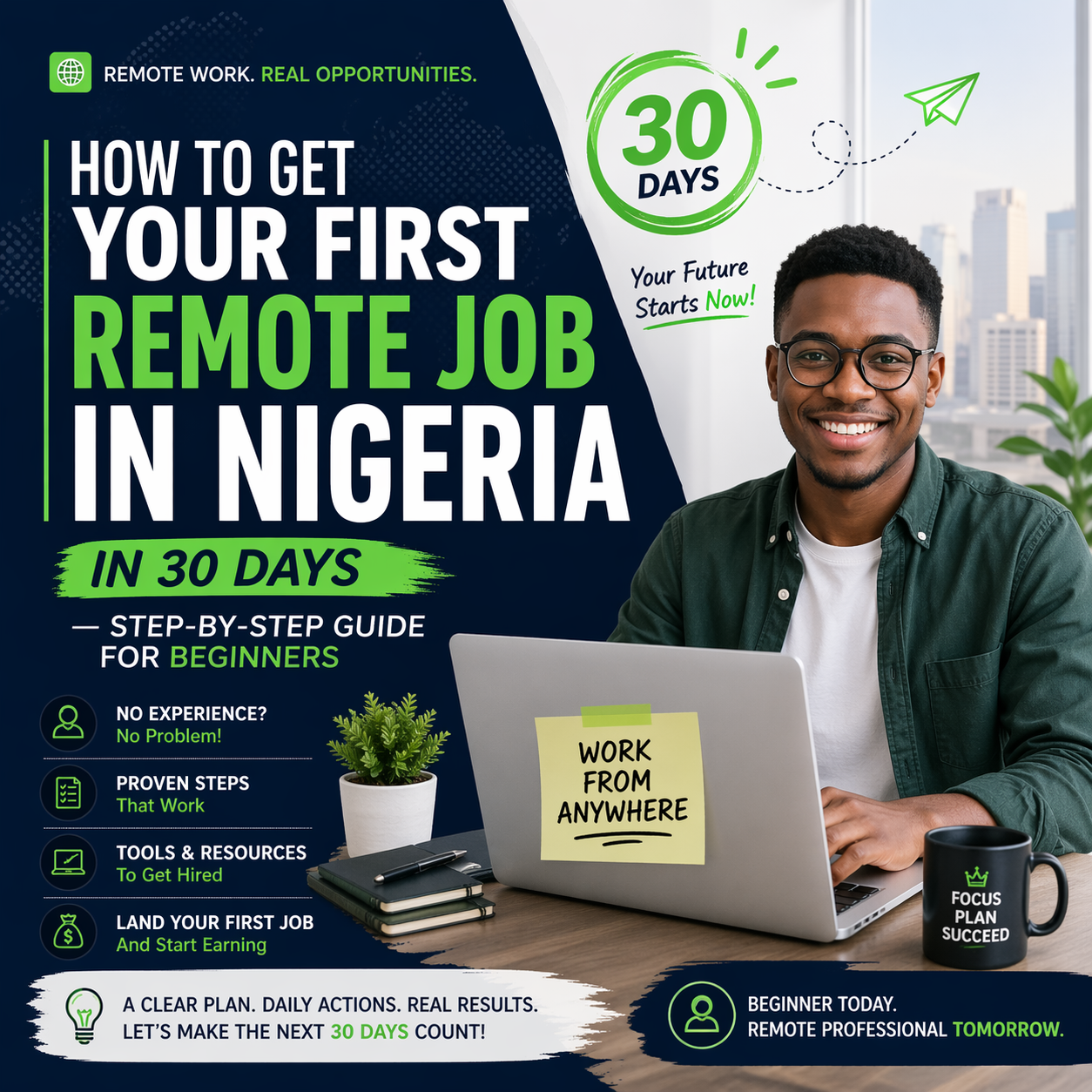
Getting a remote job in Nigeria is one of the most powerful financial moves you can make in 2026 — and the good news is that you do not need years of experience, a university degree, or a large investment to get started. You just need a clear plan, the right platforms, and the consistency to follow through every single day for 30 days.
This guide is built specifically for Nigerian beginners who are starting from scratch. If you follow every step in the right order, you can go from zero to your first paid remote job within a single month. Thousands of Nigerians have already done it. Here is exactly how.
Why 30 Days Is Enough to Land Your First Remote Job
Most people overestimate how long it takes to get hired remotely and underestimate how quickly things can move when you apply strategically. The truth is that companies are hiring right now, today, for roles that require no prior experience — things like chat support, website testing, data annotation, transcription, and virtual assistance.
The 30-day timeline works because remote job hunting is a volume and positioning game. The people who get hired fastest are not necessarily the most qualified. They are the ones who apply the most consistently, present themselves professionally, and target the right platforms where competition is genuinely low.
Here is how to break it down.
Week 1: Get Your Foundation Right
Day 1 to 2: Choose One Job Category to Start With
The single biggest mistake beginners make is trying to apply for every type of remote job at the same time. This scatters your energy and makes none of your applications compelling.
Instead, pick one job category from this beginner-friendly list and commit to it for your first 30 days:
- AI data trainer (no coding needed, pays $25–$45/hour on DataAnnotation.tech)
- Website tester (pays $10–$30 per test on Userlytics and Userbrain)
- Online chat support (pays $15–$25/hour on SupportShepherd and Remotive)
- Transcription (pays $15–$25/hour on GoTranscript and TranscribeMe)
- Virtual assistant (pays $15–$30/hour on TimeEtc and Boldly)
Pick the one that feels most natural to your current skills and move forward.
Day 3 to 4: Build a Simple One-Page Resume
You do not need a fancy resume. You need a clean, honest, one-page document that tells an employer three things: who you are, what you can do, and how to reach you.
Use Canva (free) to design your resume. Choose a clean template with good spacing. Include your name, contact email, a brief two-sentence professional summary, a skills section, and any relevant experience — even informal experience counts, like helping a family member manage their business or running a personal social media page.
The goal is to look professional and credible, not to impress. Simplicity wins here.
Day 5 to 7: Create Accounts on Your Target Platforms
Go to the specific websites for your chosen job category and create complete, detailed profiles. Upload your resume. Fill in every section. A half-complete profile signals that you are not serious, and most platforms will rank you lower in their internal search results.
For platform-based jobs like DataAnnotation or GoTranscript, you will also need to pass a short entry assessment. Do not rush this. Take it seriously, because your score determines the quality and volume of tasks you receive.
Week 2: Start Applying Every Single Day
Day 8 to 14: The Daily Application Routine
Starting from Day 8, your job is simple: apply to at least 10 remote job listings every day. That means 70 applications by the end of the week. This number might sound overwhelming, but with practice each application takes only 5 to 10 minutes.
Here is the daily routine that works:
- Spend 20 minutes browsing your target job boards (Remotive, WeWorkRemotely, SupportShepherd, DynamiteJobs)
- Shortlist 10 to 15 roles that match your chosen category
- Write a short, customised 3-sentence cover message for each one
- Submit all applications before noon
- Track everything in a simple spreadsheet: company name, role, date applied, response received
The spreadsheet is critical. It keeps you organised, helps you follow up at the right time, and shows you patterns in which types of roles respond fastest.
How to Write a Cover Message That Gets Responses
Forget long, formal cover letters. For remote entry-level jobs, short and clear is better. Use this simple structure:
“Hello [Name or Team], I am interested in the [Job Title] role. I have strong [relevant skill] and [relevant skill], and I am fully available to work your required hours. I am reliable, communicative, and ready to start immediately. I would love the opportunity to discuss this further.”
That is it. Under 80 words. Personalise the skill mentions to match each job description and you will stand out from the majority of applicants who copy and paste the same generic message to everyone.
Week 3: Follow Up and Sharpen Your Profile
Day 15 to 21: Follow Up on Previous Applications
By Day 15 you will have submitted 70 or more applications. Some will have been ignored. This is completely normal — the response rate for remote jobs averages between 5 and 15 percent. That means for every 100 applications, you can realistically expect 5 to 15 responses.
For any application that has gone 5 to 7 days without a reply, send one polite follow-up message:
“Hi [Name], I wanted to follow up on my application for the [Role] position submitted on [Date]. I remain very interested in this opportunity and would be happy to provide any additional information. Thank you for your time.”
Follow-ups increase your response rate significantly. Most candidates never follow up, which means doing so alone sets you apart.
Improve Your Profile Based on What You Observe
By Week 3 you will have data. Look at your spreadsheet and ask: which types of roles are getting responses? Which platforms are responding fastest? Which cover messages seem to get more engagement?
Double down on what is working. If website testing is getting faster responses than transcription, shift more of your daily applications toward that category. Flexibility and observation are your competitive advantages as a beginner.
Week 4: Close the Deal
Day 22 to 30: Convert Interviews Into Offers
By Week 4, you should have at least a few conversations in progress — whether that is an assessment invitation, a Zoom or Google Meet interview, or a trial task request. Here is how to handle each one:
Assessment tasks: Take your time. Read all instructions carefully twice before starting. Accuracy always matters more than speed on first assessments.
Video interviews: Test your camera, microphone, and internet connection the night before. Show up on time, dress professionally (at least from the waist up), and speak clearly and slowly.
Trial tasks: Treat these like real paid work. Many companies use trial tasks to make final hiring decisions. Your performance here is the most important factor.
What to Do If 30 Days Pass Without an Offer
If you reach Day 30 without a job offer, do not be discouraged. It does not mean you failed — it means you need to adjust one or more variables. Review these five things:
- Are you applying to at least 10 roles per day consistently?
- Is your resume clear and professional?
- Are your cover messages personalised and concise?
- Are you targeting beginner-friendly platforms with low competition?
- Did you pass the platform entry assessments properly?
Fix whichever of these is weakest and continue for another 30 days. Many Nigerians land their first remote job between Day 20 and Day 50. The ones who give up at Day 15 never find out how close they were.
Final Word
The process of getting your first remote job in Nigeria is straightforward, but it requires real consistency. There is no shortcut. What separates the Nigerians earning dollars from home from those still searching is simply this: the ones who are earning kept applying every day until something worked.
Start today. Build your resume. Create your profiles. Apply every morning. Follow up every week. Within 30 days, your first dollar-paying remote job is closer than you think.



GIPHY App Key not set. Please check settings