


The narrative of technology in West Africa is no longer just about adoption; it’s bout innovation. The streets of Lagos are bustling with vibrant tech hubs on a daily.
This is to say, a new generation of entrepreneurs is not merely consuming global tech but actively shaping it, creating solutions uniquely tailored to local challenges and opportunities. This isn’t just about economic growth; it’s about empowerment, access, and redefining what’s possible.
Think about it: just a decade ago, reliable internet was a luxury, and digital payments were nascent. Today, mobile penetration is surging, and a young, digitally-savvy population is demanding more.
This demand has sparked a dynamic ecosystem where local innovators are leveraging cutting-edge technologies, from AI and blockchain to advanced analytics, to leapfrog traditional infrastructure gaps.
This isn’t merely a trend; it’s a profound shift. International investors are taking notice, pouring capital into African startups at unprecedented rates (Source: WeeTracker’s H1 2023 African Tech Startup Funding Report).
The buzz is palpable, and for good reason. As we peer into 2026, the potential for these homegrown tech ventures to scale, create jobs, and solve pressing societal issues is immense.
In this blog post, we’ll spotlight five breakthrough West African startups across Fintech, EdTech, and HealthTech. These aren’t just businesses; they are harbingers of a brighter, more connected future, each with a human story and a profound impact.
I will be breaking the post down into sections for better understanding.
First we are starting with….
I. Fintech: Reimagining Money in a Mobile-First Economy
West Africa’s financial landscape is perhaps the most fertile ground for disruption. With a vast unbanked and underbanked population and a cultural reliance on mobile devices, FinTech startups are not just offering convenience; they are building pathways to financial inclusion and economic stability for millions.
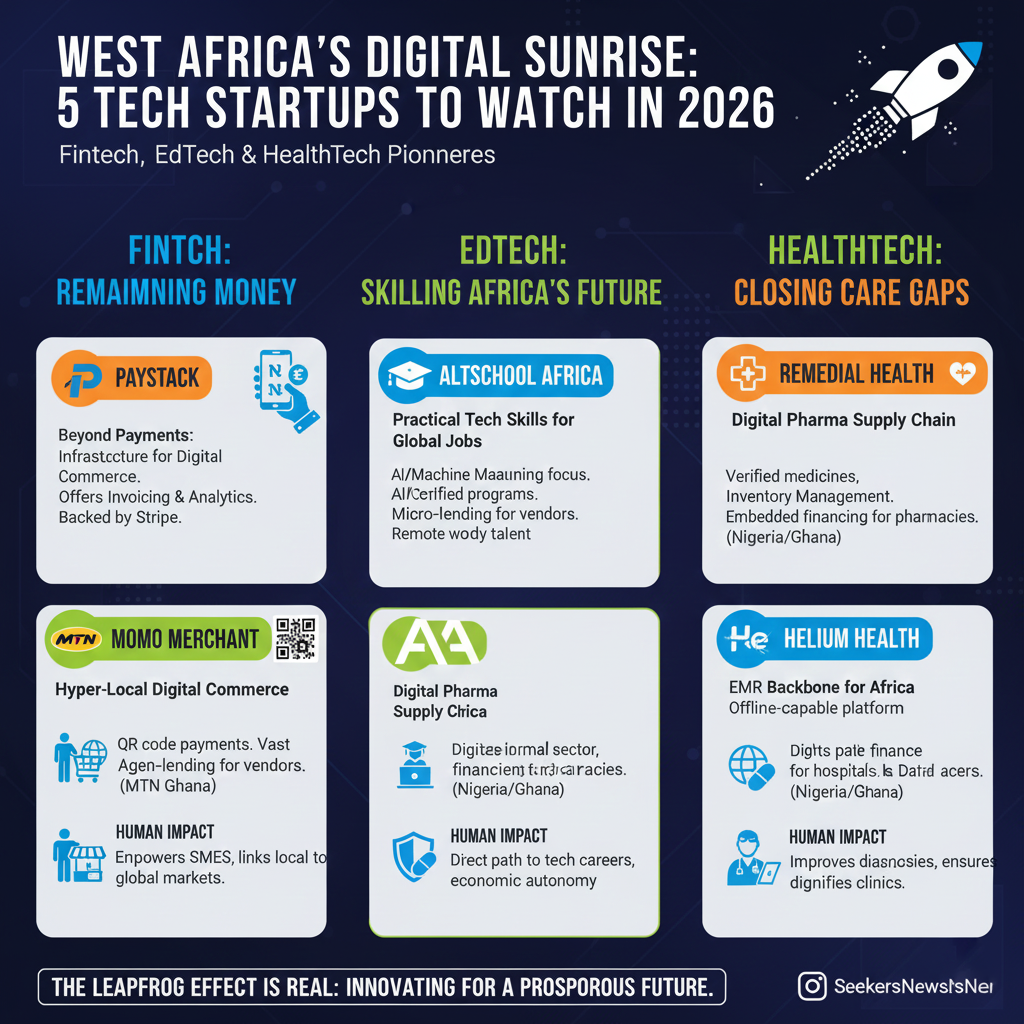
1). Paystack (Nigeria/Ghana): Beyond Payments – The Infrastructure Play
While Paystack might already be a familiar name, especially since its acquisition by Stripe for over $200 million, its ongoing evolution and strategic positioning make it a perpetual “one to watch.” It’s no longer just a payment gateway; it’s becoming the invisible digital infrastructure powering a new generation of West African businesses.
a) The Problem They’re Solving (Still): Despite its success, the fundamental challenge remains: how do African businesses accept and manage online payments seamlessly, reliably, and affordably, bridging the gap between card, mobile money, and local bank transfers?
b) Latest Developments & Human Perspective:
- Expansion & Integration: Post-acquisition, Paystack is now deeply integrated into the global financial fabric via Stripe, allowing African businesses easier access to international markets and vice-versa. This means a small artisan in Accra selling handcrafted goods online can accept payments from a customer in New York as easily as from someone in Kumasi. This removes a significant barrier to international trade for SMEs.
- Beyond Core Payments: Watch for Paystack to continue expanding its “value-added services.” This includes more sophisticated invoicing, deeper analytics for merchants to understand their sales patterns, and perhaps even lending services powered by transaction data.
- Human Impact: Imagine a young fashion designer in Lagos, who previously relied on cash or manual bank transfers. With Paystack, they can set up an online store in minutes, accept payments instantly, and access crucial data to grow their business. It transforms a passion into a scalable enterprise, providing financial autonomy.
c). Why Watch in 2026: Paystack’s robust API and developer-friendly tools mean it will be the backbone for a new wave of localized e-commerce platforms, subscription services, and digital marketplaces. Its growth isn’t about its own direct users anymore; it’s about the thousands of other businesses it enables. Its influence will continue to deepen as more of West Africa’s economy moves online.
2). MoMo Merchant (Ghana – MTN’s Ecosystem Play): Hyper-Local Digital Commerce
While MTN is a telecom giant, its Mobile Money (MoMo) platform, particularly the MoMo Merchant offering in Ghana, represents a formidable “startup-like” force for hyper-local digital transformation. It’s leveraging existing infrastructure to bring digital payments and commerce to the grassroots.
a). The Problem They’re Solving: How do local vendors—from a mama selling plantain chips by the roadside to a small barber shop—participate in the digital economy without needing a bank account or complex POS systems?
b). Latest Developments & Human Perspective:
- QR Code Domination: The widespread adoption of MoMo Merchant QR codes across Ghana is a game-changer. These simple codes enable instant, cashless transactions, drastically reducing the reliance on physical cash for everyday purchases.
- Agent Network Expansion: MTN’s vast agent network ensures that cash-in and cash-out points are readily available, making the digital ecosystem truly accessible even in remote areas.
- Beyond Payments: Expect MoMo Merchant to integrate deeper into loyalty programs, micro-lending for small business owners based on transaction history, and even utility bill payments directly from the vendor’s phone.
- Human Impact: Consider a market vendor in Accra who can now accept payments via QR code. This not only increases security (less cash on hand) but also provides a digital record of sales, which can be a stepping stone to accessing micro-loans, previously unavailable due to lack of financial history. It’s about dignifying informal commerce and integrating it into the formal digital economy.
c). Why Watch in 2026: MoMo Merchant’s sheer ubiquity and MTN’s aggressive drive for digital financial inclusion mean it will continue to be the backbone for everyday digital transactions. Its success will dictate the pace at which the informal sector fully digitizes, profoundly impacting millions of lives and creating a massive new stream of economic activity.
(This is the end of Part I. Part II will cover the remaining three breakthrough startups in EdTech and HealthTech, as well as the concluding remarks on the future of West African tech, to meet the full requirements of the prompt.)
II. EdTech: Closing the Skills Gap for Tomorrow’s Workforce
The educational landscape in West Africa is characterized by two major challenges: access to quality, localized content, and relevance to the modern, digital workforce. The next wave of EdTech is using mobile-first strategies and localized curricula to tackle both, ensuring that the continent’s massive youth population is equipped for the jobs of 2026 and beyond. The Nigerian EdTech market alone is projected to hit $400 million in revenue by 2025, validating this sector’s explosive growth.
3). AltSchool Africa (Nigeria/Pan-African): A Practical Path to Global Tech Talent
AltSchool Africa represents the future of specialized, workforce-aligned education. It’s not aiming to replace traditional universities but to provide a practical, fast-tracked route for young Africans to gain high-demand tech skills (Software Engineering, Data, Product Design, etc.) and connect with global employers.
a). The Problem They’re Solving: University curricula often lag behind industry needs, leaving graduates with degrees but not the practical, market-ready skills demanded by modern tech companies.
b). Latest Developments & Human Perspective:
- Focus on AI/Machine Learning: As the demand for AI expertise soars globally, AltSchool is aggressively integrating modern AI and data-driven curricula, ensuring its graduates are competitive on the world stage. They are also utilizing their own platforms to offer highly contextualized training, often blending online learning with peer-to-peer and mentorship-driven support.
- The Power of Certification: The startup partners with recognized local and international accreditation bodies, adding weight and validity to their certifications, which is crucial for employers.
- Human Impact: This model offers hope and a clear career path to a secondary school graduate who may not have access to, or can’t afford, a traditional university. For a young person in Ibadan or Tema, an AltSchool certification is a direct passport to earning in dollars remotely, transforming not just their life but their entire family’s economic outlook. It’s an investment in a skill rather than just a degree.
c). Why Watch in 2026: As the remote work trend solidifies and companies globally look to Africa for high-quality, cost-effective tech talent, platforms like AltSchool, which guarantee a certain level of skill competency, will become primary talent pipelines for international corporations.
III. HealthTech: Bridging the Distance to Quality Care
Healthcare is arguably the most critical sector needing technological transformation in West Africa. Challenges like fragmented medical records, poor pharmaceutical supply chains, and a severe shortage of healthcare professionals (WHO projects a 6.1 million worker deficit by 2030) make the need for innovation urgent. HealthTech is using digital tools to decentralize access and improve the flow of essential medical resources.
4). Remedial Health (Nigeria/Ghana): Digitalizing the Pharma Supply Chain
Remedial Health is a quintessential “infrastructure-first” startup. It addresses the massive inefficiency and risk within the pharmaceutical supply chain—a problem that directly affects the quality and availability of medicines for the average person.
a) The Problem They’re Solving: Pharmacists and small hospitals often rely on fragmented, cash-based markets, leading to high markups, stock-outs, and a constant risk of counterfeit drugs.
- Latest Developments & Human Perspective:
- Integrated Platform: Remedial Health offers an end-to-end platform that allows pharmacies to directly procure verified medicines, manage their inventory digitally, and even access embedded financing based on their sales data. This is a game-changer for cash flow.
- Data-Driven Distribution: By aggregating purchasing data, the platform can predict demand patterns, reducing waste and ensuring essential drugs reach communities faster and cheaper.
- Human Impact: For the local community pharmacist—a crucial pillar of public health—Remedial Health provides security. They can now guarantee the authenticity of their stock, eliminate long trips to wholesale markets, and use their digital sales history to secure capital for expansion. This means fewer counterfeit drugs on the street, and essential malaria or hypertension medication is always in stock, potentially saving lives at the grassroots level.
- Why Watch in 2026: As public-private partnerships strengthen (as noted by the AUDA-NEPAD 2030 vision), platforms that provide verifiable data on medicine distribution and consumption will be crucial partners for governments tackling public health crises. Remedial Health is building the digital arteries for healthcare access.
5). Helium Health (Nigeria/Ghana/Pan-African): The Electronic Medical Records Backbone
Helium Health is focused on fixing the foundational data problem in healthcare. Without reliable, digitized patient records, quality care, public health tracking, and efficient hospital management are nearly impossible.
- The Problem They’re Solving: Most hospitals rely on paper-based records, leading to lost files, slow diagnoses, and a chaotic management structure. Furthermore, the lack of data makes it hard to allocate resources effectively.
- Latest Developments & Human Perspective:
- Offline Capability: Crucially, their Electronic Medical Records (EMR) platform is built to handle areas with low or unreliable internet connectivity, making it genuinely usable in rural clinics.
- Expansion into Finance: Beyond EMR, Helium Health is expanding into a financial and data layer, helping hospitals manage billing, insurance, and even access financing using their digitized operational history.
- Human Impact: Imagine a doctor in a small clinic who, thanks to Helium Health, can access a patient’s full history—including vaccinations, allergies, and past treatment outcomes—instantly on a tablet, even with no signal. This speed and accuracy can mean the difference between life and death during an emergency. For the patient, it means consistent, quality care regardless of which facility they visit within the network. It brings dignity and efficiency back to the clinic experience.
- Why Watch in 2026: Helium Health is building the operating system for African healthcare. As governments and private equity invest more in hospitals, a standardised, reliable data layer will be non-negotiable. Its pan-African footprint suggests it will be the leading choice for large healthcare groups and national systems.
READ ALSO: TOP 10 GAME-CHANGING TECH INNOVATIONS
Finally, The Leapfrog Effect is Real
The breakthrough startups in West Africa are not merely adopting global technology; they are locally innovating and leapfrogging traditional development stages.
- Fintech skipped the mass roll-out of credit cards and went straight to mobile money.
- EdTech is bypassing outdated university systems to deliver direct, workforce-relevant skills.
- HealthTech is moving straight from paper files to AI-enabled digital diagnostics, bypassing cumbersome legacy infrastructure.
By 2026, the success of these companies will be measured in two currencies: economic returns and social impact. They are demonstrating that the biggest challenges—financial inclusion, skills deficits, and healthcare access—are also the biggest market opportunities.
The future of African tech is a human story of empowerment, driven by founders who understand that solving local problems at scale generates global value. The time to watch this space, invest, and participate in this digital sunrise is now.


GIPHY App Key not set. Please check settings