

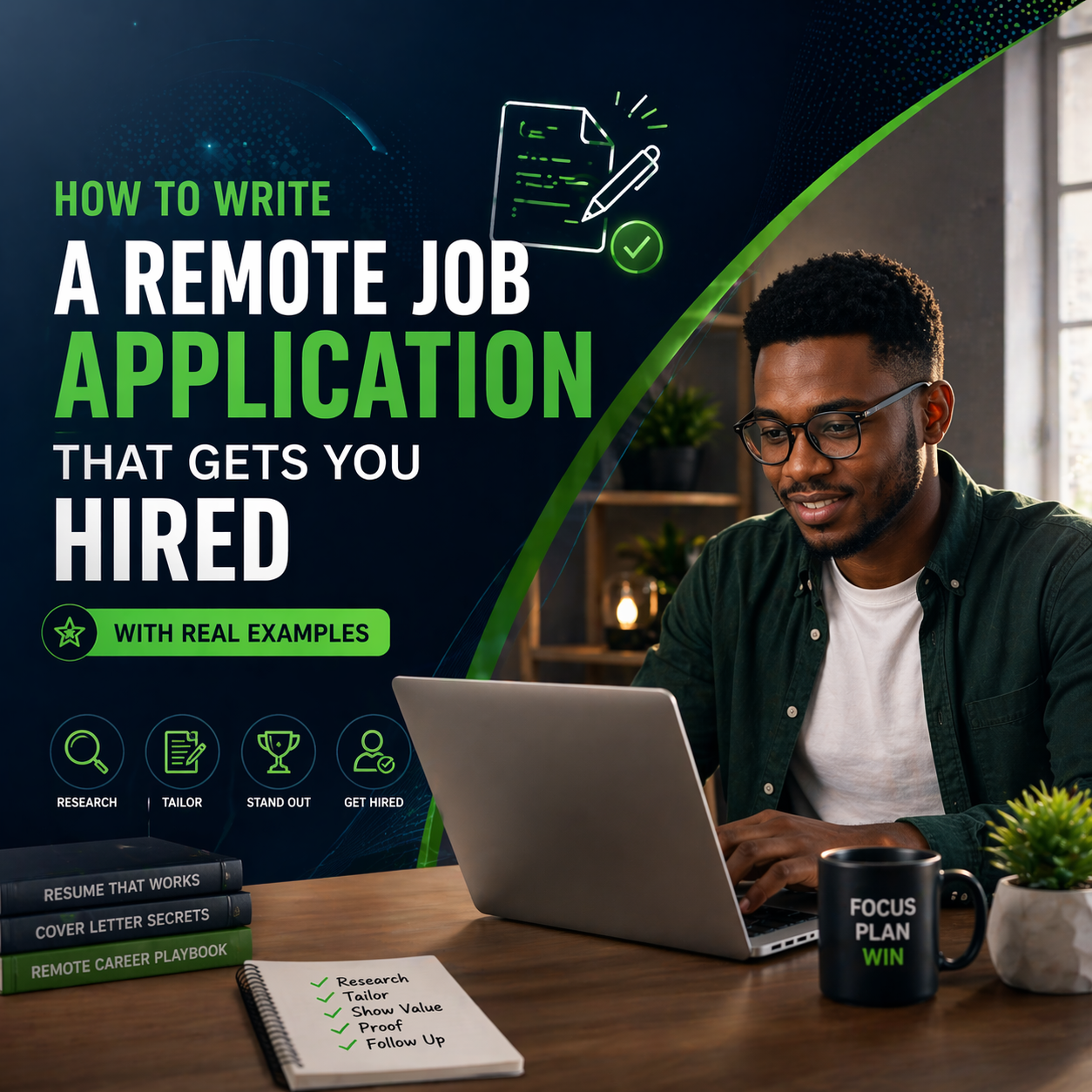
How to write a remote job application that gets you hired is a question that trips up thousands of talented Nigerians every single day — not because they lack the skills, but because they are applying the wrong way. The difference between an application that gets ignored and one that gets a response often comes down to a handful of small but critical decisions that most people never think about.
This guide breaks down every part of a strong remote job application from the subject line to the final sentence, explains exactly what international employers are looking for, and gives you real, word-for-word examples you can adapt and use immediately.
Why Most Remote Job Applications Fail Before They Are Even Read
Before diving into what works, it is worth understanding why most applications fail — because recognising these mistakes will make everything else in this guide land much harder.
The first and most common mistake is using a generic, copy-pasted cover message. Remote hiring managers receive dozens to hundreds of applications per role. They can identify a copy-paste message in the first sentence. The moment they see it, the application is finished.
The second mistake is writing too much. Many Nigerian applicants have been taught to write long, formal cover letters that demonstrate respect and thoroughness. This approach works in a local Nigerian job context. It does not work when applying to a US startup or a European company whose hiring manager is reading applications on a phone between meetings. International remote employers want short, clear, and confident.
The third mistake is focusing entirely on what you want rather than what you can do for the company. “I am applying because I want to grow my skills and gain international experience” is one of the weakest opening lines possible. The employer does not care about your career goals at the application stage — they care about whether you can solve their problem.
Fix these three things and you are already in the top 20% of applicants before the employer even reads the body of your message.
The Anatomy of a Strong Remote Job Application
A strong remote job application has five distinct parts, each serving a specific purpose. Understanding what each part is supposed to do makes writing them dramatically easier.
Part 1: The Subject Line (for email applications)
Most people underestimate the subject line. It determines whether your email gets opened at all. Keep it specific and role-focused. Never use vague subjects like “Job Application” or “Regarding the Position.”
Strong subject line examples:
- “Application — Remote Chat Support Agent | Experienced English Communicator”
- “Applying for Transcription Role — GoTranscript Qualified, 95%+ Accuracy”
- “Virtual Assistant Application | 3 Years Admin Experience, GMT+1 Timezone”
Notice what these do: they name the exact role, offer one specific credential, and signal professionalism from the first word.
Part 2: The Opening — The Most Important Sentence You Will Write
Your opening sentence has one job: to make the hiring manager want to keep reading. It must be specific, confident, and relevant to the role — not a statement about yourself.
Weak opening (what most people write):
“Dear Hiring Manager, I am writing to express my interest in the customer support position advertised on your website. I am a hardworking and dedicated individual who is passionate about providing excellent service.”
Strong opening (what gets results):
“Your listing mentioned that you need someone who can handle high-volume customer queries independently while maintaining a warm, professional tone — that is exactly what I do. I have been providing remote chat support for two years and consistently receive positive client feedback for quick resolution and clear communication.”
See the difference? The strong opening immediately demonstrates that you read the job listing, that you understand what they need, and that you have evidence to back it up. It does not start with “I” and it does not tell the employer you are applying — they already know that.
Part 3: The Body — Show, Do Not Tell
The body of your application should be two to four short paragraphs that answer one question the employer is asking themselves: Can this person actually do this job without close supervision?
Remote employers are specifically nervous about two things: can the applicant communicate clearly in writing, and can they work independently without being micromanaged? Your body paragraphs must directly address both.
Avoid these phrases entirely — they are meaningless in a remote job context:
- “I am a fast learner”
- “I am hardworking and dedicated”
- “I work well independently and as part of a team”
- “I am passionate about this opportunity”
Instead, replace every claim with a specific example or result:
- Instead of “I work well independently” — say “In my last role, I managed a full inbox queue of 80+ messages daily without supervision and maintained a 98% response-within-2-hours rate.”
- Instead of “I am a fast learner” — say “I passed the GoTranscript quality test on my first attempt and completed my first 50 audio minutes within three days of approval.”
- Instead of “I am hardworking” — say “I have completed 340 tasks on Clickworker with a 4.9 quality rating over the past six months.”
Specific numbers and outcomes are the currency of a strong application. They prove that your claims are real, not just words.
Part 4: The Timezone and Availability Statement
This is a section that most Nigerian applicants skip entirely, and it is a mistake. One of the biggest concerns international employers have about hiring from Nigeria is timezone compatibility and availability overlap. Address it directly and confidently.
Example:
“I am based in Nigeria (WAT, GMT+1) and am fully available between 8AM and 6PM WAT. This gives strong overlap with both European business hours and US East Coast mornings. I am also flexible to shift availability by one to two hours if needed to accommodate your team.”
This one short paragraph removes a major friction point and signals that you have already thought about the practical logistics of working with an international team. Most applicants never mention this — doing so alone makes you stand out.
Part 5: The Closing — Confident, Not Desperate
Your closing should be short, confident, and forward-looking. It should not beg, over-thank, or apologise. Avoid phrases like “I humbly beg to be considered” or “I know I may not have much experience but…” These undermine everything you built above.
Strong closing example:
“I would welcome the opportunity to discuss how my skills align with what you are building. I am available for an interview or assessment at your convenience. Thank you for your time.”
Then sign off with your full name, one or two relevant credentials or platform links if applicable, and your email address.
Full Example Applications by Job Type
Example 1: Chat Support Role
“Your listing for a remote chat support agent caught my attention because it specifically mentions high-volume queues and asynchronous communication — this is exactly the environment I thrive in.
I have twelve months of experience providing email and live chat support for a digital services company, handling an average of 60 to 80 queries per day. I am methodical, keep a calm tone under pressure, and always verify that the customer issue is fully resolved before closing a ticket.
I am based in Nigeria (GMT+1) and available Monday through Friday from 8AM to 5PM WAT, with flexibility to adjust. I type at 65 words per minute and am comfortable with Zendesk, Intercom, and Google Workspace.
I would be glad to complete any assessment you use as part of your hiring process. Thank you for reading this.”
Example 2: Virtual Assistant Role (No Prior Experience)
“The virtual assistant role you posted describes exactly the kind of work I have been doing informally for the past year — managing emails, scheduling, research, and keeping projects organised — and I am ready to bring that same attention to detail to a paid role.
I currently manage the administrative side of a family business, handling supplier correspondence, scheduling vendor meetings, and tracking inventory across a spreadsheet system I built from scratch. I am proficient in Google Workspace, Notion, Trello, and Slack.
I am Nigeria-based (GMT+1), available 8AM to 6PM WAT, and fully set up for remote work with a dedicated workspace and reliable internet backup. I learn new tools quickly and prefer clear, documented workflows.
I have attached my resume and welcome any task you would like me to complete as part of your evaluation. Thank you for your consideration.”
Example 3: Content Writing Role
“Strong, readable content that holds attention and drives action is something I genuinely care about — which is why your opening for a content writer caught my eye.
I have been writing blog content and product copy for the past two years, primarily for small businesses in the health and finance niches. My work consistently targets keywords without reading like a keyword list, and I always research before writing rather than relying on generic information. My average article produces a readability score above 70 on the Flesch reading scale.
I write between 1,500 and 2,500 words per day, meet all deadlines, and communicate clearly if I need clarification before starting an assignment.
I am happy to write a short sample on a topic of your choosing before any commitment is made. That way, you can judge the work itself rather than my description of it.”
Three Small Things That Make a Big Difference
Beyond the structure of the application itself, these three details consistently separate successful applicants from unsuccessful ones:
Research the company before you write. Spend five minutes on their website. Find one specific thing about what they do or how they work that you can reference naturally in your application. This single detail signals that you took the role seriously, not just any role.
Match the tone of the job listing. If the company writes their job post in a casual, friendly tone, your application can be warm and conversational. If the listing is formal and structured, mirror that formality. Companies hire people who feel like a natural fit for their culture — your tone is part of that signal.
Follow the application instructions exactly. If the listing says “apply via the form on our website”, do not email them directly. If it asks for your availability in the first message, put it there. Many companies use instruction-following as a deliberate test. Failing it disqualifies you before anyone reads your application.
Final Word
Writing a remote job application that gets responses is a skill, and like any skill, it improves with practice. Your first five applications will feel slow and uncertain. By your fiftieth, you will have a rhythm that takes fifteen minutes per application and produces results consistently.
The framework in this guide — specific subject line, strong opening, evidence-based body, timezone statement, and confident close — is the same approach used by Nigerians who are currently earning $2,000 to $5,000 per month from remote roles. It is not complicated. It just requires deliberate effort every single time you apply. Write with specificity, write with confidence, and write for the employer — not for yourself. That shift alone will put you ahead of the majority of applicants you are competing against



GIPHY App Key not set. Please check settings