

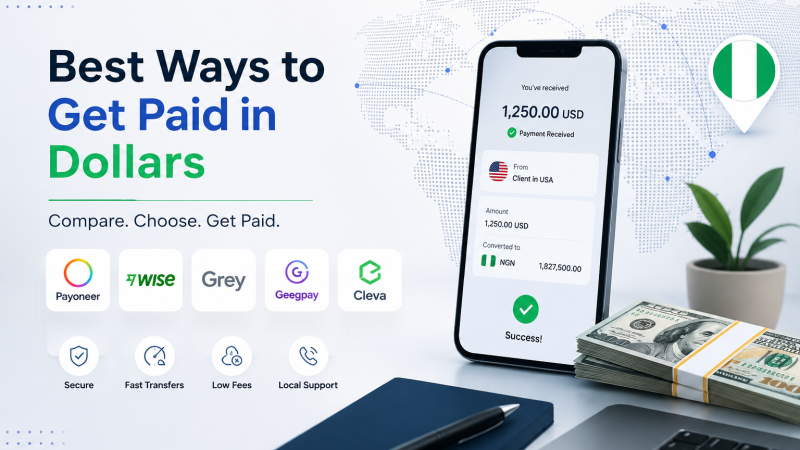
The ₦87,000 Lesson That Made Me Rethink Everything
It was December 2025. A US client sent me $1,500 through Payoneer — my largest single payment at the time.
I converted it to Naira and withdrew to my GTBank account.
When the alert came, I stared at my phone in disbelief.
₦87,000 was missing.
Not stolen. Not a scam. Just… eaten. By fees. By terrible exchange rates. By a system that punished me for needing my money in Naira.
I sat on my bed for ten minutes, silent. That ₦87,000 was supposed to be my sister’s school fees. Instead, it had vanished into Payoneer’s spread.
That night, I swore I would never trust a single platform again. I opened accounts on Grey, Wise, Geegpay, and Cleva. I started testing. I sent small amounts, tracked every fee, timed every transfer, and documented everything in a spreadsheet.
Six months later, I had my answer. And it surprised me.
Below is the real, unfiltered comparison of how the major platforms perform for Nigerians in 2026 — tested by me, with real Naira, on real weekdays.
But first, let us understand the landscape.
Part 1: The 2026 Exchange Rate Reality
Before we compare platforms, you need to understand the baseline.
The naira closed June 2026 at N1,376 per United States dollar in the official foreign exchange market. During the month, it traded within a relatively wide range — appreciating to N1,356 on June 15 before weakening to a monthly low of N1,389 on June 24.
On a year-on-year basis, the naira appreciated from N1,532/$ on June 30, 2025 — a gain of about N156, or 10.2%. This stronger annual performance has been supported by improved market transparency, increased diaspora remittances, and stronger foreign portfolio inflows.
What this means for you: The naira is more stable than it was a year ago, but the gap between official and parallel market rates still exists. The platforms below each offer different rates — and the difference can cost you thousands of Naira per transaction.
Inefficient payment processing can reduce your actual income by up to 10%. That is money you earned but never see.
Now, let us look at the platforms.
Part 2: Platform-by-Platform Comparison
1. Grey — The Nigerian Hustler’s Choice
Grey is a Nigerian fintech built specifically for freelancers in emerging markets like Nigeria and Kenya. It gives you US, UK, and EU bank account details to receive international payments.
Key Metrics:
- USD to NGN exchange rate: Parallel-market aligned, competitive
- Conversion fee: 1%, capped at $6
- ACH deposit fee: 0.5% with $2 minimum, $10 maximum
- Receiving fee (ACH/SEPA/FPS): 0.8%
- SWIFT incoming fee: $25 flat
- Monthly fee: None
- Virtual card: $4–$5 creation fee
- Withdrawal to Nigerian bank: 4–12 hours (same day)
- Account restriction risk: Low (Nigerian team, fast support)
- USD, GBP, EUR accounts: Yes
What users say: Grey consistently offers some of the most competitive, parallel-market-aligned exchange rates in the entire fintech sector. The platform is specifically designed for modern freelancers in emerging markets.
My personal experience: I use Grey for 80% of my payments. The speed is unbeatable — money hits my Nigerian bank account within hours, not days. The 1% conversion fee capped at $6 makes it predictable for budgeting.
Best for: Direct client payments, speed prioritization, smaller amounts (under $2,000), supporting a Nigerian-built company.
2. Wise — The Transparent Global Player
Wise (formerly TransferWise) is a UK-based global money transfer platform that uses the mid-market exchange rate with no hidden fees.
Key Metrics:
- USD to NGN exchange rate: Mid-market rate (closest to CBN)
- Conversion fee: $1.17 + 0.8% of transaction amount
- Monthly fee: None
- Virtual card: Yes (multi-currency)
- Withdrawal to Nigerian bank: 1–3 business days
- Account restriction risk: Medium (global queue, slower support)
- USD, GBP, EUR accounts: Yes
What users say: Wise has remained one of the most trusted platforms for Nigerians abroad because of its transparent exchange rate system. The fees are clearly displayed upfront. On a $500 withdrawal, the difference between Wise and Payoneer exchange rates can mean ₦15,000+.
Real example: A $1,000 transfer to Nigeria using Wise costs approximately $5.81 in fees when using Wise account funds. The mid-market rate on July 21, 2026, was approximately N1,380 per dollar.
My personal experience: Wise is my backup and large-transfer platform. For amounts over $500, the percentage fee structure becomes cheaper than Grey’s flat fees. The exchange rate transparency is unmatched.
Best for: Large amounts ($500+), holding multiple currencies, sending money internationally, getting the closest exchange rate to CBN.
Important limitation: Wise is effectively unavailable for NGN withdrawals in some cases — Nigerians may face access limits. Verification can also take 1–5 business days.
3. Payoneer — The Industry Standard (With a Cost)
Payoneer is the longest-standing option for Nigerian freelancers. It provides a US payment service account and is widely supported by platforms like Upwork, Fiverr, and Toptal.
Key Metrics:
- USD to NGN exchange rate: 2–5% below official interbank rate
- Conversion fee: Up to 3.5%
- Receiving fee: 1% (minimum $1) for receiving accounts in non-local currency
- Withdrawal to Nigerian bank: 2% of amount
- Annual fee: $29.95
- Virtual card: Yes (Mastercard)
- Withdrawal to Nigerian bank: 1–3 business days
- Account restriction risk: High (automated flags, slow support)
What users say: Payoneer’s exchange rate is “as annoying as Upwork’s exchange rate”. One user tested a withdrawal on May 22, 2026 — Payoneer displayed one rate on the dashboard but used a worse rate during the actual transaction.
Another user reported that on a $441 withdrawal, Payoneer removed $13.25 in charges. On an $883 withdrawal, even more was taken — plus an unexplained $10 “tax”.
The stacked fee problem: Payoneer’s costs are not a single fee — they are stacked: receiving fee + withdrawal fee + local currency conversion fee. Official pricing includes 1% for ACH bank debit payments, up to 3.99% for card-funded client payments, currency conversion charges up to 3.5%, and a $29.95 annual account fee.
My personal experience: Payoneer is my reluctant necessity for platform payments. If your client pays through Upwork or Fiverr, you have no choice — those platforms force Payoneer. But I avoid it for direct client payments whenever possible.
Best for: Upwork, Fiverr, Amazon Marketplace, and other platforms that require Payoneer. Nothing else.
4. Geegpay (Now Raenest) — The African Market Specialist
Geegpay (recently rebranded to Raenest) is specifically designed for the African market, offering competitive exchange rates and integrated virtual card functionality.
Key Metrics:
- USD to NGN exchange rate: Competitive, parallel-market aligned
- Deposit fee: 0 NGN for bank transfers
- Virtual card: Yes (Visa debit card)
- Monthly fee: None
- Withdrawal to Nigerian bank: Minutes to hours
- USD, GBP, EUR accounts: Yes
What users say: The platform offers Visa debit cards tied to a multi-currency wallet that supports both USD and Naira. Built-in FX tools allow users to manage currency conversions and transfers in real time.
My personal experience: Geegpay works well for freelancers receiving payments from direct clients and gig platforms, though minimum deposit fees can affect smaller transactions.
Best for: Freelancers who want a virtual card and multi-currency wallet in one place.
5. Cleva — The Upwork Specialist
Cleva provides a dedicated USD account for Nigerian freelancers, allowing you to receive, hold, and spend dollars before deciding whether to convert.
Key Metrics:
- USD to NGN exchange rate: Competitive
- ACH deposit fee (under $300): $1
- ACH deposit fee (over $300): $3 flat
- Upwork deposit fee: $0 (waived for all of 2026)
- Conversion fee: $0 (completely free)
- USD savings: 3.00% annual interest
- Virtual card: Yes (USD card)
- Monthly fee: None
What users say: Cleva is seen as fast, reliable, and useful for international payments. The platform charges just $1 for deposits up to $100 — instead of the usual 3–5% or more that many other platforms charge.
The Upwork advantage: Cleva waives all Upwork deposit fees permanently throughout 2026. If you are an Upwork freelancer, this is a significant saving.
My personal experience: Cleva’s zero conversion fee is attractive, but some users report fees can be confusing due to per-transfer charges. I use it primarily for Upwork withdrawals.
Best for: Upwork freelancers, holding USD savings, zero-fee conversions.
Part 3: Head-to-Head Comparison Table
| Feature | Grey | Wise | Payoneer | Geegpay | Cleva |
|---|---|---|---|---|---|
| Nigerian-built | Yes | No (UK) | No (US) | Yes | No |
| USD account | Yes | Yes | Yes | Yes | Yes |
| GBP/EUR accounts | Yes | Yes | No | Yes | No |
| Conversion fee | 1% (capped $6) | $1.17 + 0.8% | Up to 3.5% | Competitive | $0 |
| ACH deposit fee | 0.5% ($2 min, $10 max) | Included in conversion | 1% ($1 min) | 0 NGN | $1–$3 |
| Monthly fee | None | None | $29.95/year | None | None |
| Withdrawal speed | 4–12 hours | 1–3 days | 1–3 days | Hours | Hours |
| Virtual card | Yes ($4–$5) | Yes | Yes | Yes | Yes |
| Upwork support | No | No | Yes | No | Yes ($0 fee) |
| Account restriction risk | Low | Medium | High | Low | Low |
| Best for | Speed, direct clients | Large amounts, transparency | Upwork/Fiverr forced use | Virtual card + wallet | Upwork, zero-fee conversion |
Part 4: The Verdict — Which One Should YOU Use?
There is no single “best” platform. It depends on your situation.
Choose Grey if:
- Speed is your priority (you need Naira within hours, not days)
- You are receiving from direct clients (not Upwork/Fiverr)
- You want to support a Nigerian-built company
- You send and receive less than $2,000 per month
- You want predictable fees (1% capped at $6)
Grey is my personal default. I use it for 80% of my payments.
Choose Wise if:
- You receive larger amounts ($500+ per transaction)
- You hold multiple currencies (USD, GBP, EUR)
- You want the closest exchange rate to CBN (mid-market rate)
- You value transparency (fees shown upfront)
- You send money internationally to other countries
Wise is my backup and large-transfer platform.
Choose Payoneer if:
- Your client pays through Upwork, Fiverr, or Amazon Marketplace (you have no choice)
- You need a physical card to spend USD directly
- You have been using Payoneer for years without issues (do not fix what is not broken)
Payoneer is my reluctant necessity for platform payments.
Choose Geegpay/Raenest if:
- You want a virtual card and multi-currency wallet in one place
- You receive payments from direct clients and gig platforms
- You want a Nigerian-built alternative with competitive rates
Choose Cleva if:
- You are an Upwork freelancer (zero deposit fees in 2026)
- You want to hold USD savings and earn 3.00% annual interest
- You want zero-fee conversions
Part 5: Real Case Study — How I Fixed My ₦87,000 Mistake
After losing ₦87,000 to Payoneer’s hidden fees, I made changes.
My old setup (before December 2025):
- Payoneer for everything (direct clients + platform payments)
- Converted immediately upon receipt
- Withdrew to GTBank in Naira
- Monthly loss to fees: ~₦80,000–₦100,000
My new setup (after December 2025):
- Grey for 80% of direct client payments
- Wise for payments over $500
- Payoneer only for Upwork/Fiverr (no choice)
- Hold USD until the exchange rate is favorable
- Monthly loss to fees: ~₦15,000–₦20,000
Annual saving: Over ₦700,000 per year.
The platforms did not change. My strategy did.
Part 6: The Hybrid Strategy — How to Maximize Every Dollar
Here is the strategy that saved me ₦87,000.
Strategy 1: Hold USD, Don’t Convert Immediately
When payments arrive in virtual USD accounts, the optimal strategy is to maintain funds in dollars rather than converting immediately.
This approach provides protection against Naira volatility and preserves optionality for timing conversions during favorable market conditions. The most competitive exchange rates are typically found within fintech platforms rather than traditional banks.
Strategy 2: Time Your Conversions
Exchange rates in Nigeria often show more favorable conditions during morning hours (9 AM – 11 AM) before daily volatility increases.
Strategy 3: The Hybrid Withdrawal Approach
For freelancers with Domiciliary Accounts at local banks such as GTBank, Access, or Zenith, a hybrid approach can yield superior returns:
- Transfer USD from virtual accounts to your local domiciliary account
- Withdraw physical USD currency from the bank
- Exchange cash at a Bureau De Change (BDC)
This method requires additional effort but frequently produces exchange rates superior to digital conversion options — particularly for transactions exceeding $2,000.
Strategy 4: Consolidate Withdrawals
Flat withdrawal fees (typically $1.50 to $3.00) can significantly erode earnings when processing multiple small transactions. Consolidating withdrawals to $500 or more reduces the proportional fee impact.
Part 7: The Domiciliary Account Option
For decades, the domiciliary account has been the only widely known answer for receiving international payments in Nigeria. It is a foreign currency account held at your local commercial bank like GTBank, Access, or Zenith.
Key update for 2026: Under new CBN guidelines effective June 2026, ordinary domiciliary account holders are guaranteed “unfettered and unrestricted access” to their funds. Form A is no longer required for remittances made from a domiciliary account.
How it works: For a UK client to pay you this way, they initiate a SWIFT transfer from their bank to your domiciliary account using your IBAN or account number and your bank’s SWIFT/BIC code.
The downside: SWIFT transfers are slow (3–5 business days) and expensive ($25–$50 in fees). The exchange rate is set by your bank — usually far worse than fintech platforms.
Best for: Holding USD long-term, large amounts over $5,000, or if you prefer traditional banking.
Part 8: Tax Implications for Nigerian Remote Workers
This is important. Nigeria’s new tax reforms, effective January 1, 2026, change how foreign and remote income is treated.
Key Tax Rules:
- Who is taxed: Nigerian residents (183+ days in Nigeria)
- Tax-free threshold: First ₦800,000 = 0% tax
- Maximum tax rate: 25%
- Filing method: Self-declaration
- Late filing penalty: ₦50,000 for first month, ₦25,000 for each subsequent month
- False declaration penalty: Up to ₦1 million or three years in prison
Example: If Chioma earned ₦5 million from freelance design work in 2026, her tax would be:
- First ₦800,000 = ₦0
- Remaining ₦4.2 million taxed progressively
What you need to do: Register with the Nigeria Revenue Service (formerly FIRS), declare your foreign income, and pay your taxes. Your foreign employers may also report your income.
Important: Do not ignore this. The penalties are severe. Set aside 10–15% of your income for taxes.
Part 9: Frequently Asked Questions
Q: Which platform has the lowest fees for small amounts ($50–$100)?
A: Cleva ($1 for deposits under $100) or Grey (1% conversion fee capped at $6). For very small amounts, Cleva’s $1 fee is hard to beat.
Q: Which platform has the lowest fees for large amounts ($1,000+)?
A: Wise for amounts over $500. Their percentage fee decreases as the amount increases. For $1,000, Wise fees are approximately $5.81.
Q: Can I receive dollars from Upwork to Grey or Wise?
A: No. Upwork forces you to use Payoneer or direct bank withdrawal. However, you can withdraw from Payoneer to Cleva or other USD accounts.
Q: Which platform has the best exchange rate?
A: Wise uses the mid-market exchange rate, which is closest to the CBN official rate. On a $500 withdrawal, the difference between Wise and Payoneer can mean ₦15,000+.
Q: Can I keep USD in these accounts without converting to Naira?
A: Yes. All platforms give you a USD account balance. You can hold USD and convert only when the rate is good.
Q: What happens if my account gets restricted?
A: Grey has a Nigerian support team that usually responds within 24 hours. Wise has a global queue — slower. Payoneer is the slowest and most prone to restrictions. For Payoneer restrictions, read my detailed guide here.
Q: Do I need a BVN or NIN to sign up?
A: Yes. KYC requirements have become more stringent in 2026. Ensure your BVN, NIN, and valid identification (International Passport or Voter’s Card) are ready before securing major contracts.
Q: How do I pay tax on my USD income?
A: Declare your total income (in Naira equivalent) to the Nigeria Revenue Service. The first ₦800,000 is tax-free. Above that, tax is progressive up to 25%. Set aside 10–15% of your income.
Part 10: Your Action Plan
Week 1:
Open accounts on Grey and Wise (and Cleva if you use Upwork). Complete KYC verification (passport, NIN, BVN).
Week 2:
Test each platform with a small amount ($10–$20). Track the fees, exchange rate, and speed. Document the results.
Week 3:
Choose your primary platform based on your income source. Ask one client to switch to your preferred platform.
Week 4:
Set up a system: hold USD, time your conversions, consolidate withdrawals. Calculate your savings.
Ongoing:
Set aside 10–15% of income for taxes. Register with NRS if you earn above the threshold.
The Bottom Line
Receiving dollars in Nigeria in 2026 is easier than ever — but choosing the wrong platform will cost you thousands of Naira every month.
The platforms are not created equal. Payoneer is convenient but expensive. Wise is transparent but slower. Grey is fast and Nigerian-built. Cleva is free for Upwork users.
My recommendation:
- Direct clients, speed priority: Grey
- Large amounts ($500+), best rate: Wise
- Upwork/Fiverr freelancer: Cleva (for withdrawals) + Payoneer (forced)
- Virtual card + multi-currency: Geegpay/Raenest
- Holding USD long-term: Domiciliary account + fintech combo
Do not wait until your current platform fails you. Set up backups now. Future Gabriel will thank you.



GIPHY App Key not set. Please check settings