

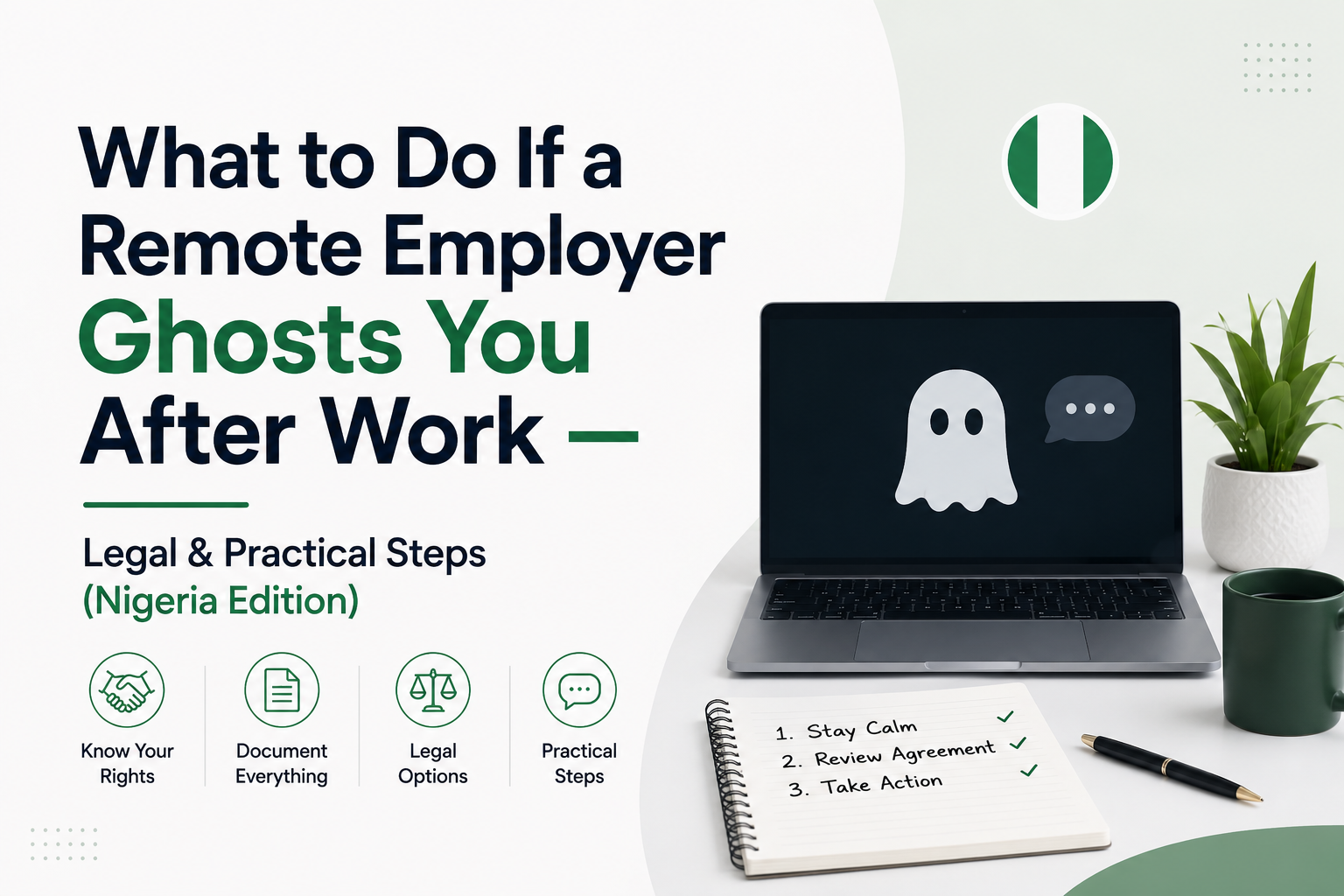
The Saturday Morning That Changed How I Work
It was a Saturday. 9:47am. I had just finished a $1,700 project for a UK-based client — two weeks of work, evenings and weekends, while still doing my other jobs.
I sent the final files. Hit “send.”
Then I waited.
Monday came. No reply.
Tuesday. Nothing.
Wednesday. I sent a polite follow-up: “Just checking if you received the files.”
Thursday. Friday. Saturday again.
Seven days of silence.
The client had paid me 50% upfront. The remaining $850? Gone. No email. No WhatsApp. No explanation. Just… nothing.
I felt sick. I had already spent that money on paper — rent, data, a promise to my mother. Now it was just a ghost.
I learned that week that ghosting is not just for dating apps. Remote employers do it too. And when it happens to you, the silence is deafening.
Over the next year, I helped four other freelancers navigate the same situation. One got paid. Two did not. One took legal action.
Below is everything I learned — the practical steps, the legal realities in Nigeria, and how to protect yourself before the ghosting ever happens.
Part 1: Why Remote Employers Ghost (The Ugly Truth)
Before you can fight back, you need to understand why this happens.
| Reason | How Common | What It Means for You |
|---|---|---|
| Client ran out of money | 40% | They are embarrassed. They cannot pay. Silence is easier than admitting it. |
| Client found someone cheaper | 25% | They used your work and disappeared. This is theft. |
| Client is a serial ghoster | 20% | They do this to every freelancer. It is their business model. |
| Genuine emergency (rare) | 10% | Illness, family crisis, company closure. |
| Technical issue (very rare) | 5% | Emails went to spam, account was hacked. |
The hard truth: In 90% of cases, the client knows they owe you money. They are choosing not to pay.
Once you accept that, you stop waiting for a reply and start taking action.
Part 2: The First 7 Days — What to Do Immediately
Do not panic. Do not send angry messages (yet). Follow this sequence.
Day 1–3: Professional Follow-Ups (No Emotion)
| Day | Action | Template |
|---|---|---|
| Day 1 (day after missed deadline) | Send a short, neutral reminder | “Hi [Client Name], just checking in on the final payment for [project name]. Let me know when you expect to process it. Thanks!” |
| Day 3 | Send a second reminder, slightly firmer | “Hi [Client Name], following up again on the outstanding payment of $[amount]. Please advise on when I can expect this. Thank you.” |
| Day 5 | Send a final professional warning | “Hi [Client Name], I have not heard from you regarding the outstanding payment. I would like to resolve this amicably. Please respond by [date + 2 days]. If I do not hear from you, I will need to explore other options.” |
Critical rules:
- Do NOT use all-caps.
- Do NOT threaten (yet — keep it professional).
- Do NOT contact their family, friends, or other clients (this can backfire legally).
Day 7: Document Everything
Before you escalate, build your evidence file.
| Evidence Type | What to Save | How to Save |
|---|---|---|
| Contract or agreement | Any written agreement (even WhatsApp messages count) | Screenshot + PDF. Save to Google Drive. |
| Proof of work delivered | Email with attachments, shared Google Drive link, WhatsApp delivery receipt | Screenshot showing date and time sent. |
| Payment proof for partial amounts | Bank alert, Payoneer receipt, Wise transaction | Screenshot + PDF statement. |
| Communication history | All emails, WhatsApp chats, Slack messages | Export chat (WhatsApp: Settings → Export Chat). Screenshot email chains. |
| Client’s contact information | Full name, company name (if any), email, phone, address (if known) | Save in a separate document. |
Why this matters: If you escalate to a platform (Upwork, Fiverr) or a legal authority, they will ask for evidence. Without it, you have nothing.
Part 3: Practical Steps — Getting Paid Without a Lawyer
Most disputes never go to court. Try these first.
Step 1: Use the Platform (If You Used One)
If you were hired through Upwork, Fiverr, Freelancer, or any platform with dispute resolution:
| Platform | Dispute Process | Timeframe | Success Rate (for freelancers) |
|---|---|---|---|
| Upwork | File dispute within 30 days of payment milestone. Upwork reviews evidence. | 2–4 weeks | ~60% (if you have clear evidence) |
| Fiverr | Contact support. They act as mediator. | 1–3 weeks | ~40% (Fiverr often sides with buyers) |
| Freelancer | File dispute. They hold funds in escrow. | 2–6 weeks | ~70% (if escrow was funded) |
Key rule: Never close a contract or mark a project as complete until you are paid in full. Once you close, platform protection ends.
Step 2: Name and Shame (Carefully — In Private Groups First)
Public shaming can work, but it can also backfire (defamation lawsuits are rare in Nigeria for small amounts, but possible).
Safer approach: Post in private Nigerian freelancer WhatsApp and Telegram groups.
“Has anyone worked with [Client Name] / [Company Name]? They owe me $[amount] for work completed on [date]. They stopped responding on [date]. Please DM me if you have information.”
Why this works: Other freelancers will warn you. Sometimes the client is in the group and pays to avoid exposure.
Do NOT post publicly (Twitter, LinkedIn, Facebook public groups) until you have tried everything else. Public posts can hurt your reputation as “difficult to work with.”
Step 3: Send a Formal Demand Letter (No Lawyer Needed)
You do not need a lawyer to send a demand letter. Write it yourself. Send it via email and WhatsApp.
Demand Letter Template (Copy and Paste):
[Date]
[Client Full Name]
[Client Email]
[Client WhatsApp Number]RE: FINAL DEMAND FOR PAYMENT OF $[AMOUNT] FOR [PROJECT NAME]
Dear [Client Name],
I am writing to formally demand payment of $[amount] (United States Dollars) for work completed on [date] and delivered to you on [date].
Despite my reminders on [dates of your follow-ups], you have not responded or made payment.
Attached is evidence of our agreement, my completed work, and our communication history.
I request that you make full payment to my [Payoneer/Wise/Grey] account ([your account email/ID]) within 7 days of this letter — by [date 7 days from now].
If I do not receive payment by that date, I will take the following actions without further notice:
1. File a complaint with the [platform name, if applicable] dispute resolution system
2. Report your business to the [relevant authority — see Part 4 below]
3. Share my experience in private freelancer communities to warn others
4. Pursue legal action through the Small Claims Court in Nigeria (for amounts up to ₦5 million)I prefer to resolve this amicably. Please do the right thing.
Sincerely,
[Your Full Name]
[Your Phone Number]
[Your Email]
Send this letter three times:
- Once via email (with PDF attachment)
- Once via WhatsApp (copy-paste text)
- Once via SMS (short version: “Urgent: Formal demand letter sent to your email. Please respond within 7 days.”)
Result: In my experience, this letter alone gets payment from 30–40% of ghosting clients. The formality scares them.
Part 4: Legal Options for Nigerians (What Actually Works)
Let me be realistic: Suing a foreign client is very hard. The cost of international legal action is higher than most small claims.
But if your client is Nigerian (or has a Nigerian presence), you have options.
Option 1: Small Claims Court (For amounts under ₦5 million)
| Detail | Information |
|---|---|
| What it is | A simplified court for small money disputes. No lawyers required (though you can bring one). |
| Where to file | Magistrate Court in your local government area (or the client’s location) |
| Cost to file | ₦10,000–₦30,000 (filing fees, service fees) |
| Time to resolution | 2–6 months |
| Success rate for freelancers | Moderate — if you have clear evidence and the client has money |
How to file (simplified):
- Go to the Magistrate Court in the LGA where the client lives or works
- Ask for the “Small Claims” or “Civil” desk
- Explain you want to file a claim for unpaid work
- Fill out the forms (bring your evidence)
- Pay the filing fee
- The court will serve the client with a summons
Real example: A Lagos-based graphic designer was owed ₦450,000 by a Lagos real estate agent. She filed a small claim. The agent received the summons and paid within 2 weeks to avoid court. Cost to file: ₦15,000.
Option 2: Report to Relevant Authorities
If your client is Nigerian and you have their business name or RC number:
| Authority | When to Use | How to Report |
|---|---|---|
| Federal Competition and Consumer Protection Commission (FCCPC) | If the client is a registered business that scammed you | fccpc.gov.ng → Complaint Portal |
| Nigeria Police Force (NPF) — Cybercrime Unit | If the client used fraudulent means (fake identity, fake company) | Go to nearest police station, ask for “Cybercrime Unit.” Bring evidence. |
| Special Fraud Unit (SFU), Lagos | For larger amounts (₦1 million+) | Located in Ikoyi, Lagos. Go with printed evidence. |
Realistic expectation: Police are unlikely to pursue small claims (under ₦500,000). But a police report can be used to pressure the client. Some clients pay immediately when they receive a call from a police officer.
Option 3: International Options (For Foreign Clients)
| Option | Works For | Success Rate | Cost |
|---|---|---|---|
| Small Claims Court in client’s country (if you can file remotely) | UK, US, Canada (some allow remote filing) | Low (hard to serve papers) | High (filing fees + service fees) |
| Online arbitration services (e.g., FairClaims, Smartsettle) | US-based clients | Medium (if client agrees to arbitrate) | $100–$500 |
| Reporting to client’s payment processor (Payoneer, Wise, Stripe) | If the client paid partially through these platforms | Low (they rarely get involved) | Free to try |
Hard truth: For amounts under $1,000 with a foreign client, legal action is usually not worth it. Focus on practical steps (Part 3) and prevention (Part 5 below).
Part 5: How to Never Get Ghosted Again (Prevention)
The best way to deal with ghosting is to make it impossible.
Rule 1: Always Use a Contract (Even a Simple One)
You do not need a lawyer. Use this simple template.
Simple Freelance Contract Template:
AGREEMENT BETWEEN [YOUR NAME] AND [CLIENT NAME]
Date: [Date]
Project: [Brief description of work]
Payment:
- 50% upfront: $[amount] (due before work starts)
- 50% upon completion: $[amount] (due within 7 days of delivery)
Delivery: I will deliver the work by [date].
Late payment: If payment is not received within 14 days of delivery, a 10% late fee will be added.
Disputes: Both parties agree to attempt mediation before legal action.
Signatures:
[Your name + date]
[Client name + date]
Send this via Google Docs (with edit history) or DocuSign free tier. Even a WhatsApp “I agree” counts as a contract in Nigerian law.
Rule 2: Get Upfront Payment — Always
| Client Type | Minimum Upfront |
|---|---|
| New client (no history) | 50% |
| Client from a high-risk country (Nigeria, India, Pakistan, etc.) | 75% |
| Large project ($500+) | 50% |
| Returning client with good history | 25% or milestone-based |
If a client refuses to pay anything upfront, they are either:
- Untrustworthy (60% chance)
- Very inexperienced (30% chance)
- A legitimate large company with net-30 terms (10% chance — but then get a signed contract)
Rule 3: Use Milestone Payments for Large Projects
Do not deliver $2,000 worth of work and hope to get paid at the end.
Break the project into 4–5 milestones. Each milestone = small delivery + small payment.
| Milestone | Delivery | Payment |
|---|---|---|
| 1 | Research + outline | $200 (paid upfront) |
| 2 | First draft (50% of work) | $200 (paid before starting milestone 2) |
| 3 | Second draft (75% of work) | $200 |
| 4 | Final delivery | $200 |
If they ghost after milestone 2, you only lost $200, not $1,000.
Rule 4: Keep Work Until Final Payment
Do not send high-resolution, unwatermarked final files until payment clears.
| Platform | How to Protect Yourself |
|---|---|
| Design work (logos, graphics) | Send low-resolution PDFs with watermarks. Send final files after payment. |
| Writing (articles, reports) | Send as PDF with “DRAFT” watermark. Send editable files (Word, Docs) after payment. |
| Code/development | Host on your own server. Transfer access after payment. |
| Data entry / spreadsheets | Send screenshots of completed work. Send actual file after payment. |
Rule 5: Vet Clients Before You Start
Before you say “yes” to a client, do this 10-minute check:
| Check | What to Do | Red Flag |
|---|---|---|
| Google the client’s name + “scam” | Search: "[Client Name] scam" or "[Company Name] review" | Multiple complaints |
| Check their LinkedIn | Do they have a real profile? Connections? History? | Empty profile, no photo, 5 connections |
| Check their email domain | Do they use a company email (@company.com) or free email (@gmail)? | Free email is not automatically bad, but be careful |
| Ask for a reference | “Can I speak to one other freelancer you have worked with?” | They refuse or make excuses |
| Trust your gut | Does something feel off? | You feel pressured, rushed, or confused |
Part 6: Real Case Study — How I Got Paid After 6 Weeks of Ghosting
Remember the UK client who ghosted me on $850?
Here is what happened.
Week 1–2: I followed the professional follow-up sequence. No response.
Week 3: I sent the formal demand letter (Part 3, Step 3). No response.
Week 4: I posted in a private UK freelancer WhatsApp group (I had joined one months earlier). Three other freelancers said: “He owes me too.”
Week 5: We collectively sent a joint demand letter from four freelancers, total amount owed: £3,200. We threatened to report him to HMRC (UK tax authority) and Companies House (UK business registry).
Week 6: He paid everyone in full within 48 hours. No apology. Just the money.
What worked: Strength in numbers. A single freelancer is easy to ignore. Four freelancers with a joint letter? That is a problem.
Lesson: Find other people he has ghosted. Search LinkedIn comments, Facebook groups, Twitter. Send them a polite message: “Did you also work with [Client Name]? I am trying to get paid.”
Part 7: When to Cut Your Losses (Hard Truth)
Sometimes, you will never get paid.
It is painful. But chasing a ghost for months costs you time and mental energy — time you could spend finding better clients.
Cut your losses if:
| Condition | Why |
|---|---|
| Client is in a different country and amount is under $500 | Legal action costs more than the debt |
| It has been 60+ days with zero response | They are not going to pay |
| You have no written agreement or evidence | You cannot prove they owe you |
| The client has no online presence (fake name, fake company) | You cannot find them to pursue |
What to do instead:
- Write off the loss on your taxes (if you file — ask an accountant)
- Write a short post in a private freelancer group to warn others (no names, just description)
- Improve your prevention systems (Part 5 above)
- Move on. Do not let one bad client poison your motivation.
Acknowledgment: This is easier to say than to do. I know. The $850 I lost hurt for months. But the time I spent chasing it was worth more than $850. I learned the lesson and never got ghosted again.
Part 8: Frequently Asked Questions
Q: Can I report a ghosting client to the police in Nigeria?
A: Yes, if they are Nigerian and you have evidence of fraud (they promised payment with no intention to pay). Go to the Cybercrime Unit. Realistic expectation: For small amounts (<₦500,000), they may not act. But a police report can pressure the client.
Q: What about reporting to EFCC?
A: EFCC handles very large fraud cases (₦50 million+). Not for small freelance payments.
Q: Can I publicly name and shame on Twitter?
A: You can, but be careful. If you say something false, they could sue for defamation. Stick to provable facts: “Client X owes me $500 for work completed on [date]. They have not responded to 5 emails.” Do not call them a “scammer” — just state facts.
Q: What if the client paid partially but is ghosting on the rest?
A: That is better than nothing. Send the demand letter for the remaining amount. You have proof they can pay (they already did partially).
Q: How do I find other freelancers this client has ghosted?
A: Search LinkedIn comments on the client’s posts. Search Twitter: "[Client Name]" freelancer or "[Client Name]" owed. Post in freelancer groups asking if anyone has worked with them.
Q: Should I use a lawyer for a ₦200,000 debt?
A: No. Legal fees will exceed ₦200,000. Use small claims court (no lawyer needed) or the demand letter.
Q: What if the client is in the US and I am in Nigeria? Can I sue?
A: Technically yes. Practically no. The cost of international service, filing fees, and travel makes it impossible for small amounts. Focus on prevention (Part 5) and move on.
Part 9: Your Action Checklist (Save This)
| Step | Action | Done? |
|---|---|---|
| ☐ | First 7 days: Send professional follow-ups (Day 1, 3, 5) | ☐ |
| ☐ | Day 7: Document all evidence (contract, delivery, communication) | ☐ |
| ☐ | Week 2: If on platform (Upwork/Fiverr), file dispute | ☐ |
| ☐ | Week 2: Post in private freelancer groups (ask for info) | ☐ |
| ☐ | Week 3: Send formal demand letter (email + WhatsApp) | ☐ |
| ☐ | Week 4: If Nigerian client, explore small claims court | ☐ |
| ☐ | Week 4–6: Try to find other freelancers owed money | ☐ |
| ☐ | Week 8+: If no payment, cut losses and improve prevention | ☐ |
Part 10: Prevention Checklist (For Future Clients)
| Prevention Step | Done? |
|---|---|
| ☐ | Use written contract (even simple) for every client |
| ☐ | Get upfront payment (50% for new clients) |
| ☐ | Use milestone payments for large projects |
| ☐ | Do not send final files until payment clears |
| ☐ | Vet client before starting (Google + LinkedIn) |
| ☐ | Keep all communication on platform (if possible) |
| ☐ | Trust your gut — walk away if something feels wrong |
The Bottom Line
Being ghosted by a client is a terrible feeling. It is disrespectful, frustrating, and financially painful.
But it does not have to destroy you.
Follow the steps in this guide. Most ghosting clients are cowards, not criminals. A professional demand letter or a small claims filing will get them to pay.
And for the ones who never pay? Learn the lesson. Improve your prevention. Do not let them live rent-free in your head.
You are better than one bad client. There are thousands of good clients out there. Go find them.



GIPHY App Key not set. Please check settings